
Building Together
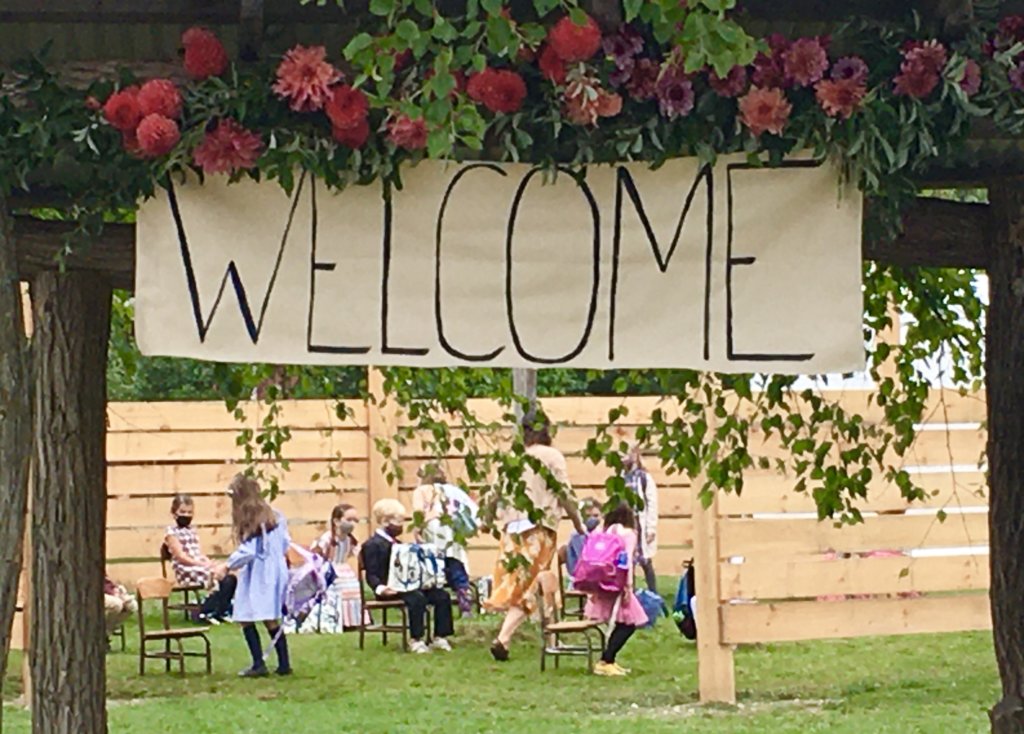
Along with all Massachusetts schools, Berkshire Waldorf School (BWS) closed for in-person classes March 13, 2020 due to COVID-19. This summer, trustees, teachers, parents and staff tapped their talents the way students tap maple trees here in the spring. After months of planning and building, classes reopened September 8, 2020, on campus in new outdoor classrooms.
Powered by Community
The BWS Board of Trustees appointed Karen Fierst as the school’s Reopening Coordinator. Ms. Fierst’s career spans teaching and then serving as an administrator at prestigious New York City schools. Most recently, she was Head of the Lower School at the Green School in Bali, Indonesia (which operated under another daily threat—a live volcano).
“FIRST WE BUILT THE MINDSET TO DEAL WITH UNCERTAINTY. WE PRIORITIZED COMMUNITY, ADAPTABILITY AND SHARED RESPONSIBILITY, SO THAT WE ARE READY TO FACE WHATEVER COMES.”
Reflecting on the collaborative process of reopening, Ms. Fierst said, “We all took a deep breath, and focused on education for sustainability.
“First we built the mindset to deal with uncertainty. We prioritized community, adaptability and shared responsibility, so we are ready to face whatever comes.
“We created a flexible calendar that chunks the school year into seasons. That allows us to extend school days into summer, if need be.
“And we are very fortunate to partner with the BWS Medical Advisory Panel, a group of esteemed local doctors who are parents at the school. They give us the flexibility to make informed and autonomous decisions, based on metrics and state, CDC and local safety guidelines.
“Next, we rolled up our sleeves and built outdoor, open-air ‘cottages.’ Our reopening was truly thanks to teams of volunteers who dug post holes, constructed weatherproof desks out of tree stumps, and hung shade sails over our forest ‘base camps.’
“Berkshire Waldorf School showed the true spirit of community—building something together. Finally, we reopened slowly and gently. The finishing touches of our reopening plan were designed based on real experience. Our reward? Being able to serve children and their families with on-campus, in-person learning.”
“BERKSHIRE WALDORF SCHOOL SHOWED THE TRUE SPIRIT OF COMMUNITY—BUILDING SOMETHING TOGETHER.”
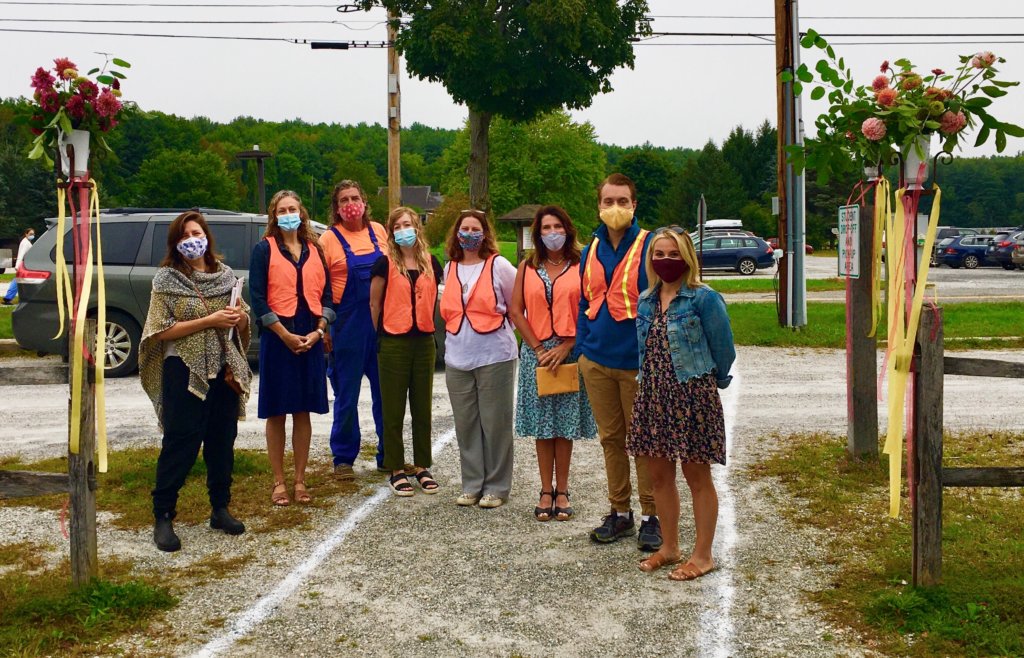
A sense of belonging
Fortunately, the State of Massachusetts continues to prioritize in-person learning. Building on our community’s capacity for flexible and creative adaptation, BWS is now celebrating the Season of Light, as we enter deep winter. How can we help you close the “six-foot gap”?
The magic of a handmade holiday is a BWS tradition – this year you’ll find our 48th Holiday Handcraft Auction online December 7-18.
Peek into life at BWS with our upcoming virtual visits, plus family “Looking Ahead” events, all from the comfort of home. No need to book a sitter!
We are accepting Fall 2021 applications for students 18 months through 8th grade right here.
We hope you’ll join us.
What do we celebrate when we celebrate Thanksgiving?
We are all so ready for some celebration. We have almost made it through the fall term, miss our friends and family, and long for a sense of normalcy, to help orient ourselves in this disorienting time.
How do we celebrate, when not everyone is celebrating? This year, we are truly thankful for another journey around the sun. To celebrate in the midst of so much loss, when the earth is calling for a time of introspection and healing, means holding our families close. From closeness comes comfort and calm.
Our community’s outpouring of generosity in this time of need, by actions such as giving food to the Peoples’ Pantry, is a start at widening the circle of love and support to our neighbors. Part of what we celebrate with sharing is that the Indians in what is now Plymouth, MA gave “essential survival knowledge to the Pilgrims and taught them how to cultivate the land, including teaching them which crops grew well, how to avoid dangerous and poisonous plants, and how to extract sap from maple trees.”
Do we see the mercy and the generosity of people who did not see the “other” as an enemy, but as a human being? Do you know what became of Ousamequin, know as Massasoit or great sachem (leader), and Tisquantum (Squanto), and how this generosity was repaid?

The “First Thanksgiving”
In a speech planned for the 350th anniversary of the Pilgrims’ landing at Plymouth rock in 1970, Wampanoag Wamsutta James wrote these remarks:
It is with mixed emotion that I stand here to share my thoughts. This is a time of celebration for you—celebrating an anniversary of a beginning for the white man in America. A time of looking back, of reflection. It is with a heavy heart that I look back upon what happened to my People.
Even before the Pilgrims landed it was common practice for explorers to capture Indians, take them to Europe and sell them as slaves for 220 shillings apiece. The Pilgrims had hardly explored the shores of Cape Cod for four days before they had robbed the graves of my ancestors and stolen their corn and beans. Mourt’s Relation describes a searching party of sixteen men. Mourt goes on to say that this party took as much of the Indians’ winter provisions as they were able to carry.
Massasoit, the great Sachem of the Wampanoag, knew these facts, yet he and his People welcomed and befriended the settlers of the Plymouth Plantation. Perhaps he did this because his Tribe had been depleted by an epidemic. Or his knowledge of the harsh oncoming winter was the reason for his peaceful acceptance of these acts. This action by Massasoit was perhaps our biggest mistake. We, the Wampanoag, welcomed you, the white man, with open arms, little knowing that it was the beginning of the end; that before 50 years were to pass, the Wampanoag would no longer be a free people.
National Day of Mourning
Instead, James was not allowed to speak these words. Since the year his speech was suppressed, this day has marked a National Day of Mourning. Moonanum James and Mahtowin Munro explain:
Every year since 1970, United American Indians of New England have organized the National Day of Mourning observance in Plymouth at noon on Thanksgiving Day. Every year, hundreds of Native people and our supporters from all four directions join us. Every year, including this year, Native people from throughout the Americas will speak the truth about our history and about current issues and struggles we are involved in.
Why do hundreds of people stand out in the cold rather than sit home eating turkey and watching football? Do we have something against a harvest festival?
Of course not. But Thanksgiving in this country—and in particular in Plymouth—is much more than a harvest home festival. It is a celebration of the Pilgrim mythology.
According to this mythology, the pilgrims arrived, the Native people fed them and welcomed them, the Indians promptly faded into the background, and everyone lived happily ever after.
The truth is a sharp contrast to that mythology.
Telling the Story is Teaching the Story
In eighth grade American history, our students learn about Revolution—the French Revolution, American Revolution, French and Indian Wars, the so-called Beaver Wars, and the Industrial Revolution. To the victor go the spoils. The victors also control the story, which includes the stories in children’s books and textbooks.
So consider the story of the “First Thanksgiving” as just that, a story—the New York times recently called it a myth. American Indian Movement activist Russell Means called Thanksgiving “Thankstaking.” He also points out that there were many feasts in Plymouth when the Indians shared food with their starving neighbors, but that the first “official” Thanksgiving Governor William Bradford declared was in gratitude for the massacre of an Indian village. Even Parenting Magazine writes, “Thanksgiving signifies a whitewashing of history, and an attempt to deflect from the atrocious harm caused to indigenous groups by European settlers.”
True History of U.S. (Us)
On First Nations Day this year, Pumpkin Patch kindergarten teacher and member of the BWS Diversity, Equity and Inclusivity (DEI) Committee Christianna Riley visited the New England Peace Pagoda. She writes:
I had the great privilege of being invited to the New England Peace Pagoda’s 35th Inauguration Ceremony (socially distanced and responsible). I am including the link to a livestream that was taken. This is for parents only. The part I would like to share with you begins around 48 minutes into the livestream, a beautiful song and then a speech given by Sonia Little of the Mashpee Wampanoag Nation, located in what we now call Cape Cod, Mass. Sonia is the granddaughter of the late Supreme Medicine Man of the Wampanoag People, Slow Turtle. She gives a heartbreaking, clear and concise truth about the history of the USA and the First Nations of Turtle Island. I believe that hearing Sonia speak is a deed of great courage. This is the history of the USA and of Humanity. We are all related and connected. This is an offering to raise our awareness and to know history so that we can make a better future for our children and the Earth.
We are Grateful
So you might be wondering, What do I tell my children about Thanksgiving?
Start with learning about Thanksgiving and ways to practice gratitude from Indian writers and storytellers. Learn about food sovereignty, and consider adding diversity to your celebration with a dish that includes rich indigenous flavors like corn, beans and squash. Some resources are listed below.
While it’s important that parents know and listen to the truth of history, third grade teacher Victoria Cartier points out that you will want to tune what you say to your children’s age and development. For example, with early childhood students, the focus is on making the food and saying a blessing for all the good gifts of the earth. “And I would add gratitude to nature,” Mrs. Riley suggests. “Taking walks in nature, being in wonder and admiring its beauty. Young children are so good at finding ordinary rocks or sticks as beautiful and special treasures. We can learn from them.” With third graders, Ms. Cartier says she would emphasize generosity, working together for the good of all, and gratitude. In eighth grade, children are ready for and seek the truth, and that’s a time to share more details. In high school, students will want to act for justice.
Making Space for Listening
Some believe that the world will not heal until the earth can heal, and that in order to restore health, nations who have been “removed” must return to their sacred homelands. The water protectors, as you know, stood at Standing Rock for all of us—people and animals alike. The Lenape, who traded Manhattan for trinkets because they couldn’t conceive of selling the earth, are beginning to return to New York, working to teach what they know to save the earth for all. Once again, we are hungry in so many ways, and winter is approaching. Can we listen, and return generosity and mercy with respect and dignity? Can we change the end of the story this time, so all life can flourish? Let our celebration be a commitment to hearing all voices, leaving a space for silence so we can hear what the world is asking of us.
Some Resources:
We Are Grateful: Otsaliheliga by Traci Sorell
Squanto’s Journey: The Story of the First Thanksgiving by Joseph Bruchac
1621: A New Look at Thanksgiving by Catherine O’Neill Grace
The Thanksgiving Myth Gets a Deeper Look This Year
How to Celebrate Native Americans This Thanksgiving
Listen to Indigenous American Podcasts
Cook 10 Essential Indigenous Foods with The Sioux Chef
Faces of the Lenape Tribe, the Original Inhabitants of Manhattan
Massasoit’s Strategic Diplomacy Kept Peace With the Pilgrims for Decades
Greetings, all my relatives
In honor of First Nations Day, and to begin the work of truth and reconciliation, we want to acknowledge that our school is on the traditional territory of the Muhhekunneuw (Mohican) Nation, the people of the flowing waters, whose territory originally ranged west beyond the Muhheakantuck (Hudson) River, the “river of tides,” from which they take their name.
In their own language, the Mohican referred to themselves as the “Muhhekunneuw” (ma-hee-kan-ok), “people of the great river.” This name was difficult for the Dutch to pronounce, so they settled on “Manhigan,” the Mohican word for wolf and the name of one their most important clans. Later, the English altered this to the now-familiar Mahican or Mohican.

Words can divide or multiply, add or subtract. So it’s important to note that Henry Hudson didn’t “discover” the Hudson River; it was the site of a thriving civilization, whose people had adapted to live as part of the land, waters and wildlife of the River Valley skillfully and with great success for 10,000 years. The Muhhekunneuw had 40 important council fires, up along what is now the Hudson Valley as far north as Lake Champlain and Lake George; their winter home was on the banks of the Housatonic River. These were the people who met the Half Moon, as it followed the tidal river on its second journey to find a shorter route to China, greeted Henry Hudson and his sailors, and taught them all they knew about living in this plentiful land.

Donald Shriver, president emeritus of the Union Theological Seminary in New York, and Stephen Kent Comer, last lineal survivor of the Mohican Nation in the vicinity of Columbia County, added a historical marker alongside the already-existing History of Columbia County marker at the northernmost overlook of the Taconic Parkway. The original marker tells of Hudson’s arrival in 1609, with no mention of the Mohicans. Comer noted, “When I came to this area thirty years ago, I was amazed to find virtually nothing about my people in their native land. It was as though we were a ghost people.”
One of the most important ways we can acknowledge the elders and ancestors who cared for this beautiful land is to acknowledge their presence by speaking of them in the present tense. The remnants of the mighty Mohican nation are alive and well and living in Wisconsin. Their demise (in The Last of the Mohicans) has been greatly exaggerated.
We can learn more about how the Mohican Nation came to be known as “Stockbridge Indians”and why they live in Wisconsin today.
What sacred land do we stand on? We can honor Indian nations by respectfully acknowledging ancestral lands.
We can honor ancestors and elders by caring for this land with the same reverence, tenderness and gratitude. For example, we thank the plant before we take a leaf for food or medicine.
We can honor tribal rights by referring to indigenous people in this country as American Indians. Since all the treaties the U.S. made were with “American Indians,” using this term upholds Indian rights and dignity as sovereign nations.
We can read books with our children by and about American Indians. We can savor the work of the Poet Laureate of the United States, Joy Harjo, the first American Indian poet appointed to that role.
We can remember the words of an Indian grandmother to her grandchild: “I am nothing without you,” and acknowledge on a daily basis that our survival depends on respecting our connectedness rather than living in our differences, so the choices we make will be in the best interest of many people.
Berkshire Waldorf School Distance Learning Bridges Social Distancing
Imbue yourself with the power of imagination,
Have courage for the truth,
Sharpen your feeling for the responsibility of the soul.
Rudolf Steiner inspired the first Waldorf teachers with this verse over 100 years ago, and it’s helping our teachers stay true to Waldorf education values—even while they adapt to the sudden and dramatic challenge of distance learning—by keeping the human being central to their work.
Fast Response
“On the Friday we closed, teachers worked together to create a plan we could start immediately,” said school director Lynn Arches. “Students had a recognizable and reliable program to continue learning the following Monday. Teachers were on the phone or email Monday at 8:30 am, wishing their students good morning.”
Waldorf schools are often described as teaching “heads, hands and hearts.” Our teachers strive to engage the whole child through curiosity, imagination and action, and to relate academic, practical and artistic work through a multi-sensory, interactive approach.
With classrooms closed and students across the nation now learning at home, how do Berkshire Waldorf School teachers continue to engage the whole child? What does experiential learning look like outside the classroom?
Community, Courage, Creativity
Teachers from preschool through middle school quickly adapted their Waldorf curriculum into a holistic model that doesn’t just deliver information. In addition, they take care that students continue to feel safe, welcome, supported, and part of a larger learning community. Building on existing partnerships with parents and caregivers, BWS distance learning also includes a new layer of family support. Open lines of communication have grown between teachers and parents, teachers and students, and students with their class family.
“The first day third graders called in separately via video chat, tears welled up when we said the morning verse together, just as we’ve done every morning since first grade,” said class teacher Tracy Fernbacher.
For our youngest students, preschool and kindergarten teachers provide stories, crafts, recipes and songs—via print packages, audio and video—to support parents and help children stay in a steadying, familiar routine.
“My daughter lit up when she heard her teacher’s voice,” said parent Tess Diamond, who runs North Plain Farm in Great Barrington with partner Sean Stanton. “Our teachers set us up for so much experiential learning, and turns out, it’s working. ”
Discovering by Doing
Grade school and middle school students are used to a weekly schedule of integrated learning that includes art, movement, handwork, gardening, music, play and lots of outside time, blended with academic subjects.
“I always wanted to cook with my students,” said seventh grade class advisor Krista Palmer, who most recently taught her students to bake bread via YouTube. “Suddenly I realized, now we have a whole bunch of kitchens!”
While distance learning may seem more suited to short term memory learning such as vocabulary lists or math worksheets, Berkshire Waldorf School teachers continue to focus on linking learning concepts to students’ own experience. This depth of teaching is where creativity in distance learning really makes a difference.
“We continue learning by doing,” Arches said. “We are so fortunate to be in the Berkshires, and to work with a curriculum that isn’t all screen based. This year, we’ll start spring planting ‘in place,’ rather than in the school gardens. We go on working together as a community, and most important for our students and families, the learning goes on, even when we can’t be together.”
Caring for Very Young Children While We are Home
by Sheela Clary, The Berkshire Edge
The only thing we can control is how we show up for each other every day.

Somer Serpe
Somer Serpe is the Parent-Child Garden teacher at Berkshire Waldorf School. She works with infants through age three and a half, holding smaller versions of a nursery classroom that includes both children and parents. Their daily activities include a puppet show, circle time and movement games. Children take out the compost and feed goats, sheep and cows. Somer has been an early childhood teacher at the school for 15 years, and also helped start the Apple Blossom Family Center in Wilton, Connecticut.
Here is an excerpt from an email she recently shared with her very young charges’ parents.
Having predictability in children’s days and weeks helps them to feel safe and held like a warm, cozy blanket. They find great comfort in routine and don’t react well to spontaneity, or hours of unending stimulation. They like to hear the same story over and over or walk the same way to the market or have the same sandwich day in and day out. Often when young children insist on these habits with great force, they are actually letting us know that their world isn’t rhythmical enough, and this is one way they can manifest it themselves.
We spoke the other day in more detail about advice she’d share.
“One thing I tell parents of kids in this age group [toddlers to preschool] is to always be creating a purposeful and nourishing rhythm to the day. Children thrive on knowing what comes next, and having things come at the same time each day, and same time each week, whether it unfolds naturally or you need to create a new rhythm.
“It is so easy to throw everything out the window and have a weekful of Sundays, but in the end that does not nourish the little child, and it causes stress for all of us. The adults need a rhythmical life too. It might be the only thing we can rely on, the only place we know our roles in the day. The most important things are meal times and bed times. Those should stay constant.
“I find that having boisterous, active times together outside followed by quiet indoor play or craft, or straightening up toys, is like breathing. Children find comfort to these moments, and transitions are easier between the two. If the children know what is coming next, and the same time is given to each type of activity every day, they flow from one to the next more easily. They don’t get upset because they know what to expect next. They feel safe and held when things are the same. There are fewer tantrums and need for discipline. It’s like a ship that carries us along. Once a rhythm is established we don’t have to do a lot of thinking about, ‘What am I going to do next?’

Somer Serpe, grinding wheat with a Buttercup student.
“Young children want to do what we’re doing. The more opportunities they have to join in our daily tasks, whether it’s folding laundry or sweeping the floor, the better, because they are connecting with us. Also, by doing tasks together, they get done and when kids are down for the nap or night we have more free time for ourselves. If you’re on the computer, you can have a little desk near you where the child can imitate what you’re doing. The child has some semblance of that work, maybe a basket of favorite toys or books. If there are play spaces near where the parent is working, and they can feel your presence, they don’t feel the need to pull your attention to what they are doing. It takes time, but the more rhythmical this can be, the more they do things on their own. Once they’ve had that connection, they can go off by themselves and create their own magic.
“The younger ones need more attention, and their ability to concentrate is limited. But if you have to work while the child is awake, make your time with them really present, so they can then move away. The littlest ones can accomplish this in smaller chunks of time. Typically a two year old could not do much more than 30 minutes independently. Three year olds could work closer to 45 minutes or an hour.
“If you do everything for a two-year-old, they can’t be left much on their own. But closer to three, they want to do things on their own. They have their own mini versions of things we have. The more opportunity we can give them to do things on their own, the better. Through struggling to put on their boots and jackets, the more willing they will be to struggle to create something on their own later. This depends on how often they’ve been allowed to do things on their own.
“When children are constantly entertained by their parents, they don’t develop those skills. Boredom is great because children are on the cusp of creating something new for themselves. Children who are left on their own don’t get bored. If they are allowed the chance to be without constant stimulation, they will have the capacity to let that happen.
“It’s hard for us to let that happen. Even babies can lay on a rug and play with their hands and toes for hours, but we don’t let them do that, because we want to pick them up and cuddle them. But they can be on their own. That’s the beginning of them spending time with themselves.
“We all want the best for our children and we want them to be able to do special things, especially if we didn’t have these things when we were young. We overcompensate. But I think we forget that children have an innate capacity for imaginative play, and if we provide the right environment and step back as adults, it is magical. And every child can do it. But if they are not allowed to, they lose the capacity to do it. They’re working things out, and if they don’t now, they won’t be able to when they are adults. This is building resilience and self-love. You can play in the woods and make your own rules and learn to listen to yourself and so navigate the world.

Somer Serpe feeding sheep with Parent-Child students at the school.
“Also, remember not everything has to have an end point. It is a process. There is no outcome. There is no, ‘Now, we’ve learned it.’ It is just a flowing through life, taking in everything, and integrating it into themselves, and allowing things to unfold in their play.
“In this anxious time, we are living through ‘now,’
“For the youngest children who are just learning to be in this world, if we are showing that it’s scary and we’re stressed, it is hard for them to go forth. I like to do a quick glimpse of news in the morning and not constantly check what’s going on throughout the day. It is hard to hide our emotions, but we have to let it out where the children aren’t around us, finding time to breathe and meditate and find the silver lining and the good things that are coming out of this. Stuck at home’s flip side is that we get to eat together. We can slow down.
“It has never been like this, where we press the pause button on the world. The only thing we can control is how we show up for each other every day. The really little ones don’t need to know all about this. They feel our gestures, our thoughts. They know. But the extra love and holding and cuddles, and joyful expressions, will go a long way to help them feel safe.
“We have to be gentle on ourselves and remember our children young and old love us no matter what. We don’t have to be perfect or efficient, especially efficient. Those two things are the worst things we can strive for right now with children this age. Even if we are not having the perfect day, they love us and we love them.”
For more information and to join Mrs. Serpe’s Parent-Child classes, please contact Robyn Coe at admissions@berkshirewaldorfschool.org.